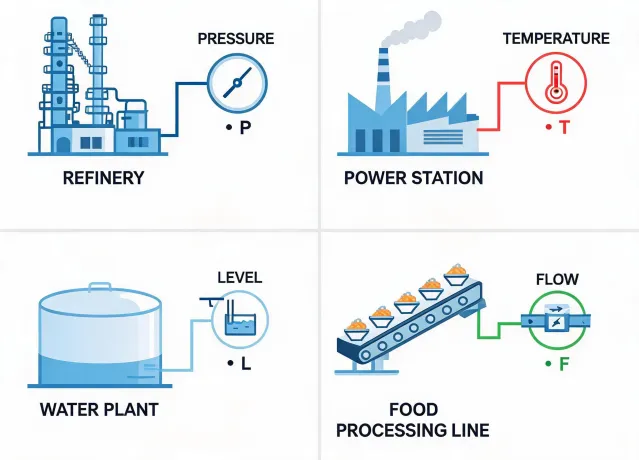
Oil, Gas & Petrochemical
Pressure, level, and flow loops on refinery columns, offshore platforms and tank-farm custody-transfer skids need documentation that distinguishes indication from custody or safety service. Ashcroft conversations may include diaphragm seal materials, pulsation handling, hazardous-area equipment marking and the service interval required for instruments exposed to heat, vibration or corrosive media.
Typical evidence: Zone classification, range, wetted materials, calibration record.
Chemical Process
Corrosion-rated transmitters, ATEX/IECEx-zone instruments, and SIS-rated final control elements require careful boundaries. A chemical loop may need Ex ia IIC T4 Ga style marking for a defined zone, while a standard utility header may only require ordinary location documentation. The page keeps those duties separate so buyers do not overstate compliance.
Typical evidence: compatibility notes, Ex marking, output signal, proof-test reference.
Water & Wastewater
Ultrasonic and electromagnetic flow meters, MID-class water metering, and aeration-blower control loops serve both utility reporting and plant control. Selection reviews address pipe size, conductivity, installation run, enclosure rating and whether the meter supports a regulatory or internal operations record.
Typical evidence: MID class when required, installation conditions, rangeability.
Power Generation
Steam-cycle pressure and temperature loops, feedwater control, and renewable inverter station instrumentation are judged by stability and service access as much as purchase cost. Ashcroft framing helps teams compare local indication, transmitter output and calibration interval for assets that may sit in high-temperature or hard-to-reach areas.
Typical evidence: process temperature, pressure class, drift history, service clearance.
Food & Beverage Process
Hygienic 3-A pressure and temperature transmitters with CIP/SIP cycles documented for the audit file need surface finish, fill fluid, process connection and cleaning-cycle compatibility stated clearly. Instrument records should support product safety reviews without claiming universal sanitary approval for every configuration.
Typical evidence: 3-A suitability, CIP/SIP cycle, seal material, calibration interval.