Selection review
Engineers verify media compatibility, overpressure, vibration, diaphragm seal needs and the correct accuracy statement before the instrument becomes part of a quote.
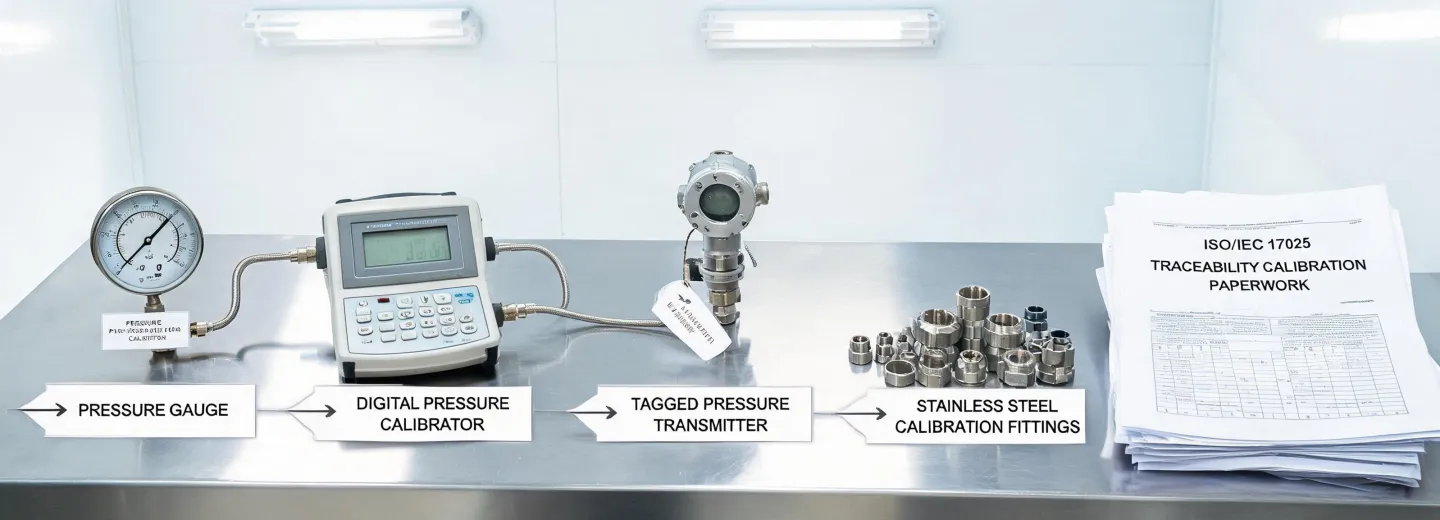
Ashcroft service planning separates what the instrument does in the loop from what the record must prove after maintenance, inspection or commissioning is complete.
Engineers verify media compatibility, overpressure, vibration, diaphragm seal needs and the correct accuracy statement before the instrument becomes part of a quote.
Calibration intervals can be tied to ISO/IEC 17025 accredited scope where appropriate, with NIST-traceable references and k=2 expanded uncertainty stated on records.
Field service notes connect replacements, spares, diaphragm seal assemblies and transmitter output checks to the asset list your maintenance team already uses.
Range, media, process temperature, connection, output protocol, enclosure rating and approval region are documented in a single service brief.
The team names tolerances such as ±0.5% span indication or transmitter reference accuracy and separates field stability from laboratory capability.
Calibration, replacement, diaphragm seal fill or switch setpoint checks are performed against the approved procedure and asset tag.
Records state reported uncertainty, reference traceability, as-found and as-left results and the recommended follow-up interval.
Send a sample asset list or describe your process loop. Ashcroft can help separate quick replacement items from instruments that require calibration scope, hazardous-area documentation or more detailed application review.